Becoming who she needed to be: remembering Violet Henry King
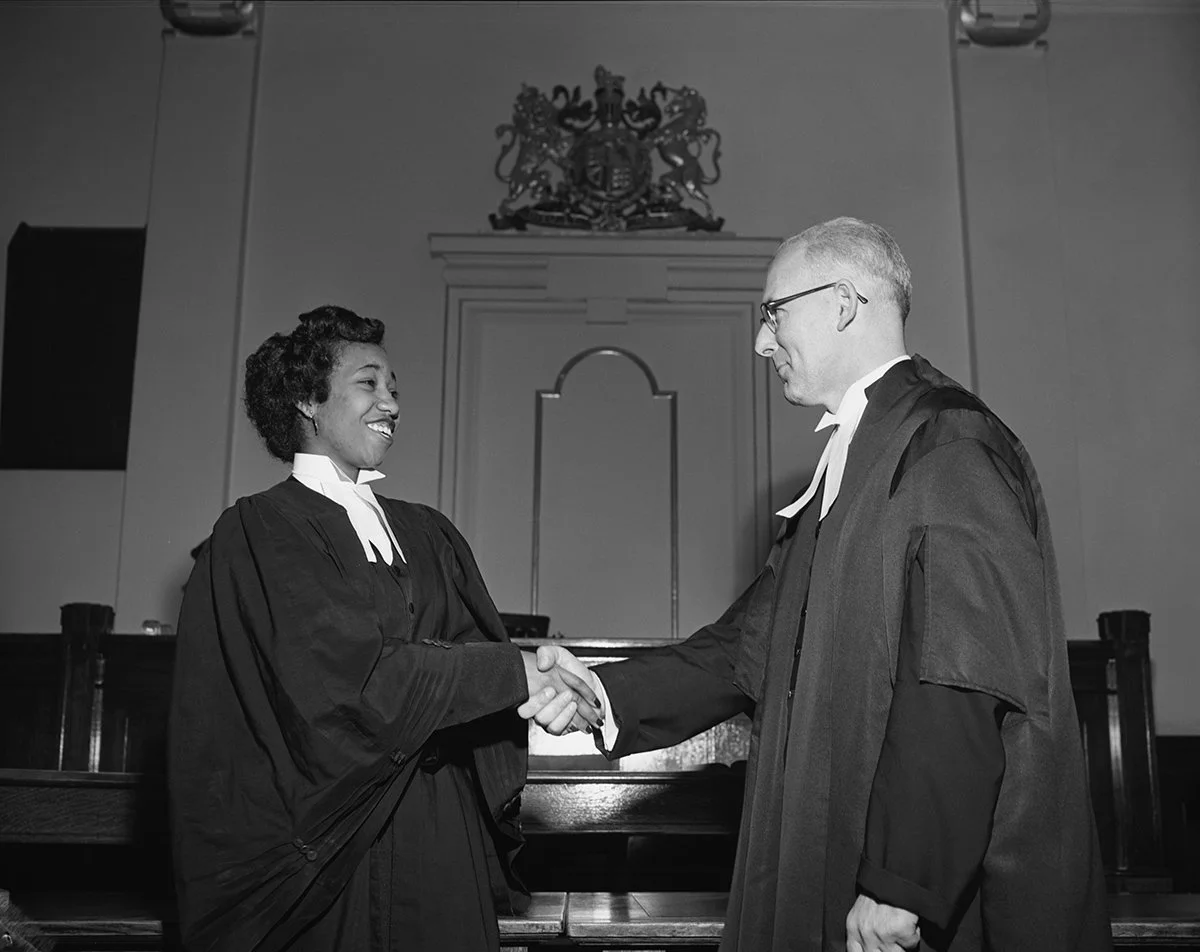
Courtesy to Glenbow Archives
“I often wish if there was one conversation that I could have with her it'd be, ‘what did it take to show up that way every day?’” Jo-Anne Henry-Bent said.
It has been nearly 42 years since the passing of Violet Henry King, the first Black person to obtain a law degree in Alberta, the first Black person to enroll in the Alberta bar and the first Black woman to become a lawyer in Canada.
King is survived by her only child, Jo-Anne who now resides in Washington D.C with her husband, Troy Bent, and their daughter, Lani. Jo-Anne reflects on the short time she had with her mother before she passed to cancer—she was only 16 years old, almost the age her own daughter is now.
“If I could be an 18th of the quality of a mom that my mom was, I would be very proud,” Jo-Anne said.
Jo-Anne remembers the independence her mother encouraged her to have from a very young age, though it’s the infectious confidence that stuck out for her. She retells a story that has been retold to her one too many times. She was six years old, and she often accompanied her mother to her work dinners.
A few years prior, in 1963 King had moved to Chicago where she held the title of director of planning and eventually director of manpower with the YMCA. Seven years later she became the first woman to be an executive director of the National Council of YMCA’s Organizational Development Group.
Jo-Anne, seated alongside her mother at a table of majority men and their wives, chatted with the man seated beside her.
“When do you want to get married?” he asked her.
“I am not going to get married,’” six-year-old Jo-Anne said.
“What are you teaching her? That is just horrible, you know you are teaching her this?” he yelled at King.
Jo-Anne smiles as she retells this seemingly small but meaningful memory of her mother, “It was such a my mom thing,” Jo-Anne said.
“She modelled for me.”
King was born in Calgary in 1929 to John and Stella King, she was one of four children followed by Vern, Lucille, and Ted. John and his extended family were part of the thousands of Black settlers in response to the Canadian government’s campaign formed to tempt US farmers to move into Alberta. CBC’s Black Life: Untold Stories series also featured this piece of history in the episode Claiming Space.
“The federal government accidentally published advertisements in Black newspapers, letting folks know that for $10 they could buy 160 acres of land,” said Karina Vernon, professor at the University of Toronto.
These ads soon enough reached prominent Black newspapers including the Boley Progress, in what is now known as Oklahoma. Though the government did not expect Black farmers to be the settlers they would attract. To prevent further Black settlements, Canadian immigration officials abused their power through fraud, deception, and bribery.
It wasn’t until 1919 that John and Stella moved into Hillhurst-Sunnyside, a small community within Calgary. King went on to high school, graduating from Crescent Heights High School.
“Violet wants to be a criminal lawyer,” captioned underneath her Grade 12 yearbook picture.
She knew who she wanted to be from a very young age.
King attended the University of Alberta; she was one of three women in the entirety of the faculty of law. During her undergraduate studies, she was the vice-president of the students’ union, and she was one of four students to be recognized for their contributions to the University of Alberta in 1952.
In 1953, one year after completing her arts degree, she obtained her Bachelor of Laws degree (LLB), making her the only woman in her graduating class and the first Black person to graduate from an Alberta law school.
In June of 1954, King became the first Black woman lawyer in Canada, and this caught several newspapers’ attention, as well as the attention of the International Brotherhood of Sleeping Car Porters and Maids, a union run by African Americans.
King practiced law until 1956 and soon after moved to Ottawa to work as the executive assistant to the chief of the Liaison Branch of Canadian Citizenship and Immigration.
The Newark YMCA’s Community Branch in New Jersey welcomed King as executive director in 1963, where King would assist Black individuals who struggled to find employment. Two years later, King and Godfrey C. Henry married and soon after gave birth to Jo-Anne.
“It was definitely my mom’s influence in the person that I am that I care about justice and why I have a very strong reaction when I see injustice.” Jo-Anne said.
Jo-Anne dedicated the majority of her career to child abuse prevention, domestic violence prevention, and other social work.
“I grew up being around someone who fought so hard for other people and advocated for so many,” she said.
Her only daughter, Lani, is experiencing her youthful girlhood years and Jo-Anne has already heard her indefinite answers to what she wants to be when she grows up.
“I think she is becoming who she needs to be,” Jo-Anne said.
She thinks of a world that she dreams to exist for her daughter, a Black woman in the US, and the increase of attention that her own mother has received in the last four years.
“I think that George Floyd and the rise of this idea that racism is dead and then the whole world being reminded for the first time that racism is so powerfully alive,” Jo-Anne said.
Jo-Anne thinks following the tragic events that led to the murder of George Floyd and the protests that followed have put a lot into perspective for all different kinds of people.
“There's a reason that education is a target,” she said.
“Because it is so powerful that teaching real history, teaching responsibility, teaching why the world looks the way it looks now and doing it well, breeds responsible citizens and responsible citizens are going to largely value equity and achieving it.”
Last year, the University of Calgary alongside the Black Law Students’ Association invited Jo-Anne to the unveiling of her mother’s portrait in the largest classroom in the university.
“To look at a room of 500 Black students, I started to cry before I even said anything,” Jo-Anne said.
Natasha Calif, a fourth-year political science Black woman student, moved from Vancouver to Waterloo to pursue her goals to become a lawyer.
“I feel like I have to work twice as hard to make it towards the same goals that others don’t,” Calif said.
“I feel like we have to constantly prove that we deserve to be there, that we can do it.”
Calif explained that she received an abnormal amount of criticism for pursuing law, oftentimes people question why she, a woman, does not pursue a different career.
“It’s inspiring to see that Violet never really had a role model, as unfortunate as that is. But it’s the fact she became that person for me and other Black women,” Calif said.
Calif thinks back to the process of moving across the country on her own, beginning education in a foreign city, and applying her experiences to figure out what is next for her.
“A long-term goal of mine is to show people like me that you can succeed,” Calif said.
“I feel like I was alone in a lot of my process. I want to be that safe haven or safe space to talk about school, or even anything else.”
Jo-Anne knows it can be easy to become overwhelmed when major events are about to take place that can affect a lot of people, such as the 2024 elections. She explains that in the face of difficult times, it can be easy to forget the power of certain basic tools such as community building, and keeping your physical and mental health healthy.
“I would love to be able to continue to look at things that look impossible and say ‘well, if it's important, what would the steps towards it be?’” Jo-Anne said.
“And start taking those steps even if it might be hard to see where it's really going to work out.”
Jo-Anne thinks her answer to the question: what do you want to continue from your mother’s legacy?
“I think that being able to just help people see the possibility that they may not see and to pursue what they want to pursue,” Jo-Anne answered, a similar response to a speech her mother gave 68 years before.
“People told me it wasn’t a good idea for a girl to be a lawyer, particularly a coloured girl,” Violet Henry King said.
“So, I went ahead.”